Chagrin Falls, Ohio
Grisaille
One material. Every shade between black and white.
Plaster relief and architectural surfaces by the hand of Peter Varga.
Fine Art
Original relief. It begins in the dark.
Penumbra: a partial region of shadow between absolute darkness and complete illumination.
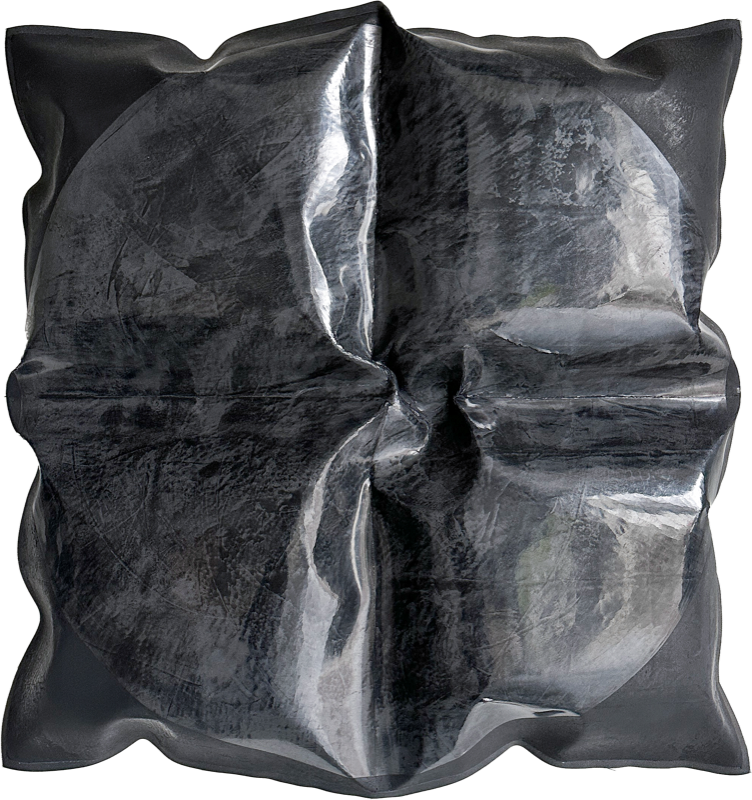
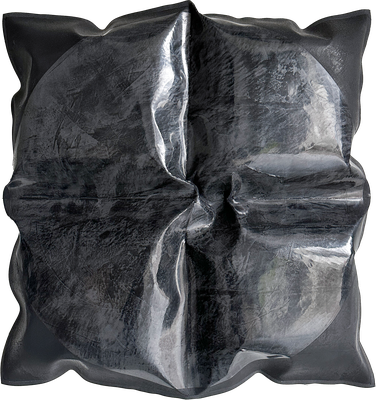
Named after different storm cloud formations, this series highlights Peter Varga's persistent goal of learning, then defying, the limitations of plaster.Studio Peter Varga

My goal is to evoke an emotional resonance with the viewer - either on a cradle or as an installation built directly onto the wall.Peter Varga

Mineral plaster treated as site rather than a surface.Studio Peter Varga


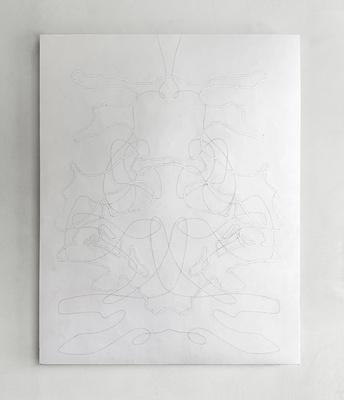
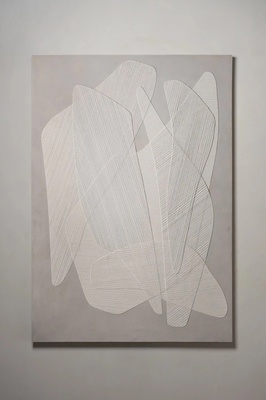
Inspired by the contortions and movements of the human body in contemporary dance under stylized lighting, the Rorschach series explores the relationship between light, surface, and abstraction.Peter Varga
Installations
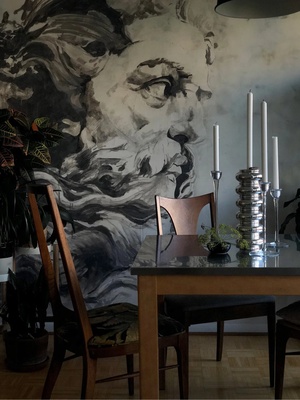
Where the art enters the room.


Surfaces
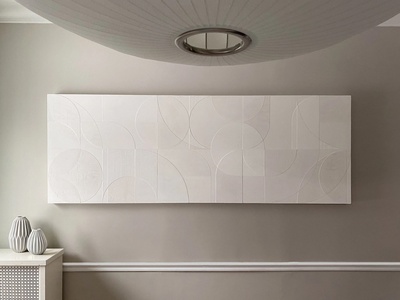
The wall itself, finished by hand.
Four finishes close this wing, in the order they stop reflecting: Hi Gloss, Metal, Pearlescent Metallic, Fluted. In the studio’s words: “Beyond their aesthetic depth, our lime-based finishes are inherently functional. Through the natural process of carbonation, these materials absorb CO2 from the air as they cure, essentially returning to a stone-like state on your walls.”
Applied wet. Polished to stone.
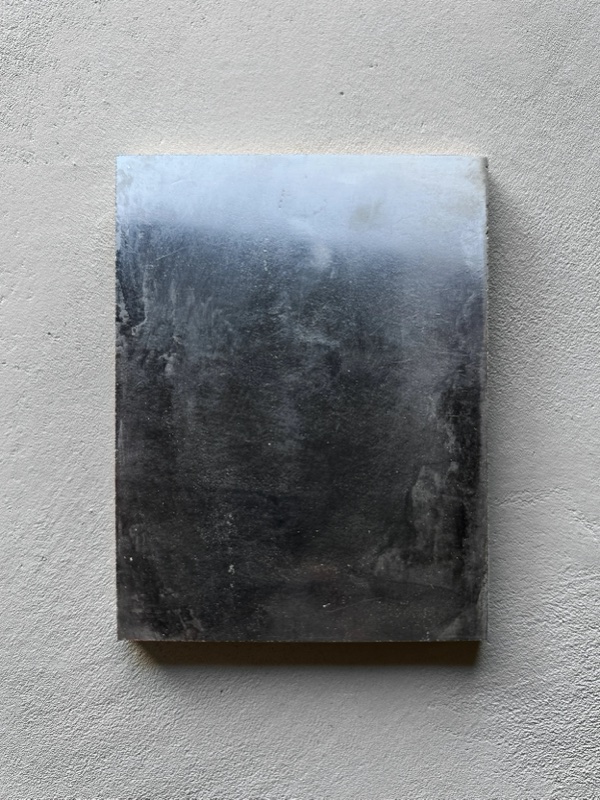
This high gloss, glass-like finish not only makes visual impact but helps regulate temperature and humidity in a space as well.Peter Varga
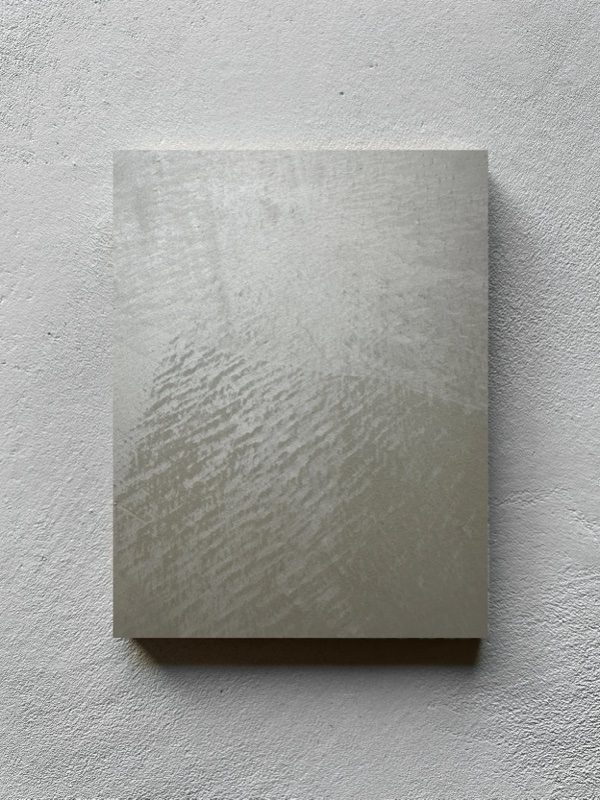
Our custom pearlescent metallic finish over lime plasterPeter Varga
The Studio
The record, in full light.
All works are original and never duplicated. Availability is noted individually. Please inquire to confirm status.
Studio Peter Varga, on selected works.
Fine Art
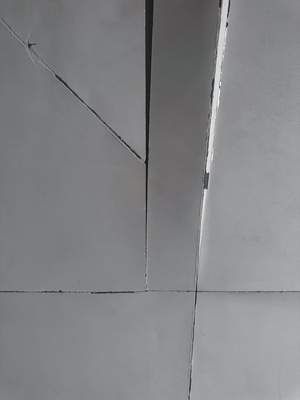
Two adjoining textures meet at a diagonal seam: a woven, canvas-like grid beside a vertically ridged surface.
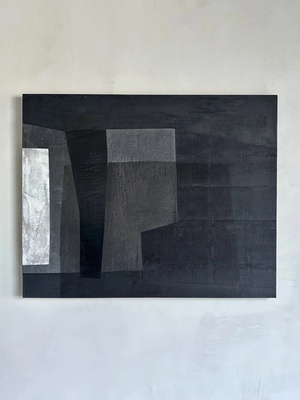
Dark charcoal geometric shapes surround a bright, pale silver-white rectangle near the panel’s left edge, shown edge to edge.
A mottled charcoal-gray field resolves into a smoother triangular facet at center, with a fine crosshatched grid visible at the lower right corner.
A bull-mask relief’s upper section: horns and a pale central arch glow against black, pebbled shoulders, set against pure black ground. The series takes its name from a Hungarian grassland region of “banditak, betyarok, csikosok es pasztorok,” its horsemen, longhorns, and black pigment translated into plaster. The piece’s near-total blackness enacts the series’ stated aim to represent “folklore, intensity, and mystery” through “rich black pigment.”
A crumpled, metallic-looking surface catches strong reflected light across deep creases, glossy and near-black. The studio describes the piece as rigid plaster “stretched, folded, and fractured into dimensional form,” pushed to its “physical and structural limits,” part of a series “named after different storm cloud formations” and built into “pillow-like sculptures.”
Shown in profile, a black canvas binding strip runs along the scalloped rim of a ring-form piece against a white wall. Like the rest of Mammatus, it is built from plaster “stretching, folding, creasing, and sculpting” into “pillow-like sculptures,” part of the studio’s stated project of defying the material’s usual limits.
A full-bleed close-up fills the frame with folded, faceted grid texture, fine scratches visible across a pale-to-mid silvery gray surface. The studio describes it, as with Mammatus 02, as plaster “stretched, folded, and fractured into dimensional form,” part of a series built to push a traditionally rigid material past its limits.
A portrait panel where black grid and waffle relief meet a smooth black field, glossy blue-black streaks pooling across the surface. The studio defines Penumbra as “a partial region of shadow between absolute darkness and complete illumination.” The panel’s shift from gridded relief into unbroken black enacts that definition directly.
A drip and splatter relief runs the panel’s length, pitted and glossy on one side, deep black with fine scratches on the other, split by a vertical seam. The series statement calls this kind of contrast deliberate: “gloss is contrasted with matte, textures against smoothness, and organic with geometric,” an experience the studio says depends on “lighting and vantage point.”
An angular wedge element casts a dramatic shadow across a combed, deep-black textured panel surface. The wedge stages the series’ stated subject at a small scale, examining, in the studio’s words, how “light and shadow recalibrate the perception of form through depth, reflectivity, and subtle shifts in surface.”
The palest piece in this grouping: radiating crack lines sit at upper left, a smooth diagonal folded panel to the right, under soft, even, pale off-white light. Where Penumbra 01, 02, and 04 work in near-black, this piece takes the series’ stated range, “varying shades of black or white,” to its lighter pole.
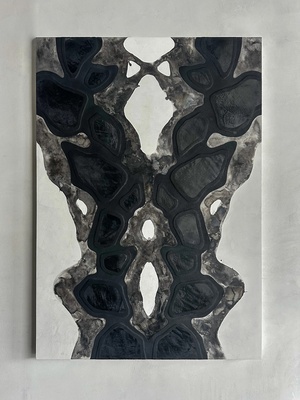
A tall vertical panel, shown straight on: a symmetric organic vein pattern, resembling a butterfly or ribcage, in black channels enclosing mirror-finish gray cells on cream ground. The studio’s record calls it a plaster relief “exploring surface depth and symmetry through layered mineral application.” The studio’s own post on Emanare: “Mineral plaster treated as site rather than a surface.”
A pale panel, mounted plainly on a light wall, carries a fine incised line drawing: looping, spine-like and gourd-like shapes in bilateral symmetry. The series draws on “the contortions and movements of the human body in contemporary dance,” the studio citing how skin, bone, and muscle inform its layered compositions.
A tall, dark relief panel on a dark charcoal wall carries the same bilateral, carved organic symmetry as the rest of the series, here in near-black charcoal with cool silvery highlights. The low tonal contrast makes the body-derived pattern harder to read at a glance than its paler counterparts.
A tight macro crop isolates carved organic lines and mesh-textured recessed sections in light silver-gray, no wall or edge in frame. The series statement locates this vocabulary in the body directly: “the way skin moves over bone, the sculptural tension of muscle, and the ways bodies connect and intertwine.”
Surfaces
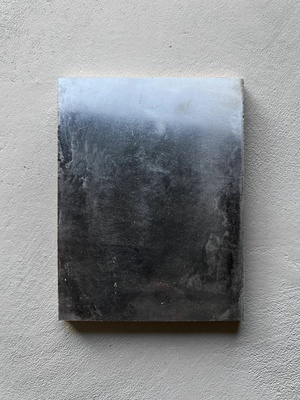
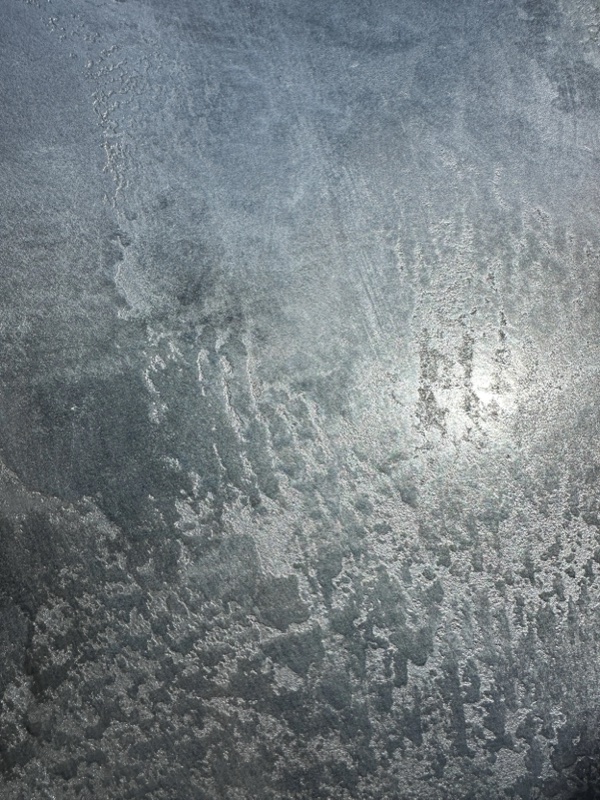
A finish sample mounted on a light gray textured wall shows a cloud-like tonal gradient from silver-blue to near-black under a mirror-polish sheen.
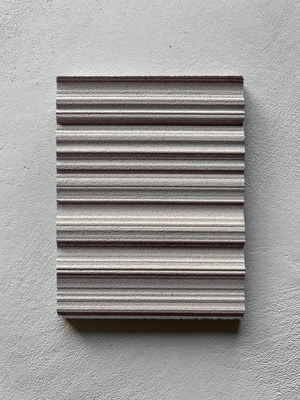
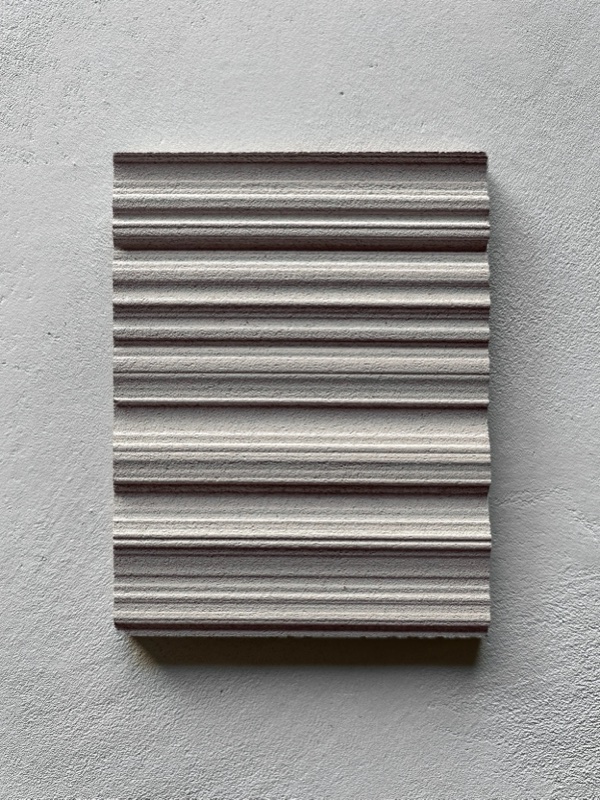
Horizontal ribbing, fine and evenly spaced, catches a strong raking light that throws each groove into shadow.
Shown in situ rather than as a swatch: a dark wood platform bed with gray, cream, and blush linens sits against a cloudy, warm mid-gray plaster wall, a black sconce above and a nightstand holding dried branches.
A small rectangular sample, photographed with a drop shadow on an off-white textured wall, shows a matte, cool-neutral stone-gray surface with faint darker veining and small pitted marks.
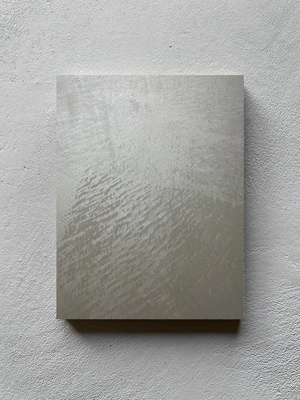
A sample mounted on a plaster wall shows diagonal raked streaking across a light warm-gray, mostly matte surface with only a faint sheen and no strong metallic glare.
A corner shot: a diagonal shaft of daylight crosses a warm off-white plaster wall, meeting a cooler, darker gray-brown wall at a sharp vertical edge. The studio describes the finish as “a matte, mineral depth with subtle striation and inherent variation,” where “tool marks remain visible, creating a layered, stone-like character.” The studio notes it is “frequently used as a defining element” such as “a hearth or primary wall plane,” and “performs equally well across varied interior contexts.”
A macro diagonal close-up shows fine, parallel vertical grooves combed into a cool mid-gray, matte surface, the panel’s edge visible at lower right.
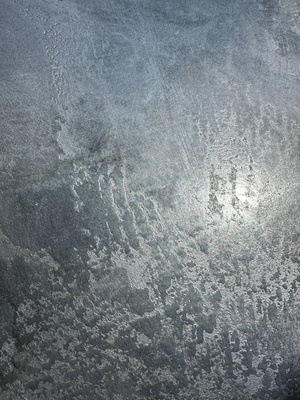
A full-frame macro shows a steel-blue metallic finish, mottled between darker and lighter passages with a bright reflective glare right of center.
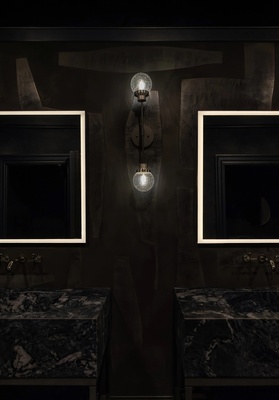
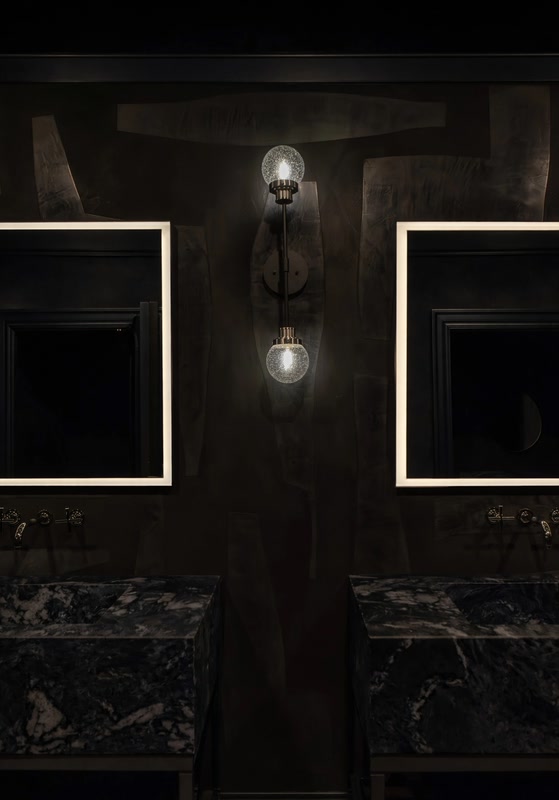
A dark bathroom vanity: mottled silver-on-black plaster walls frame a tall mirror flanked by sconces with glass-orb bulbs, above a black veined-marble countertop and walnut drawer cabinetry.

Varga learned patience, precision, and an attentiveness to surface that continues to shape his work.
Studio Peter Varga, artist profile.
Raised in Hungary. Nearly a decade of training under a master fresco painter. More than twenty five years in plaster. A family studio.
Varga worked in the traditional Roman fresco method across churches, theaters, and historic buildings throughout Europe, including projects within the Vatican.
Studio Peter Varga, artist profile.
Commissions and consultations by inquiry.
Consultations are always complimentary.
Studio Peter Varga, contact.
Chagrin Falls, Ohio
Taking projects throughout the US and internationally.